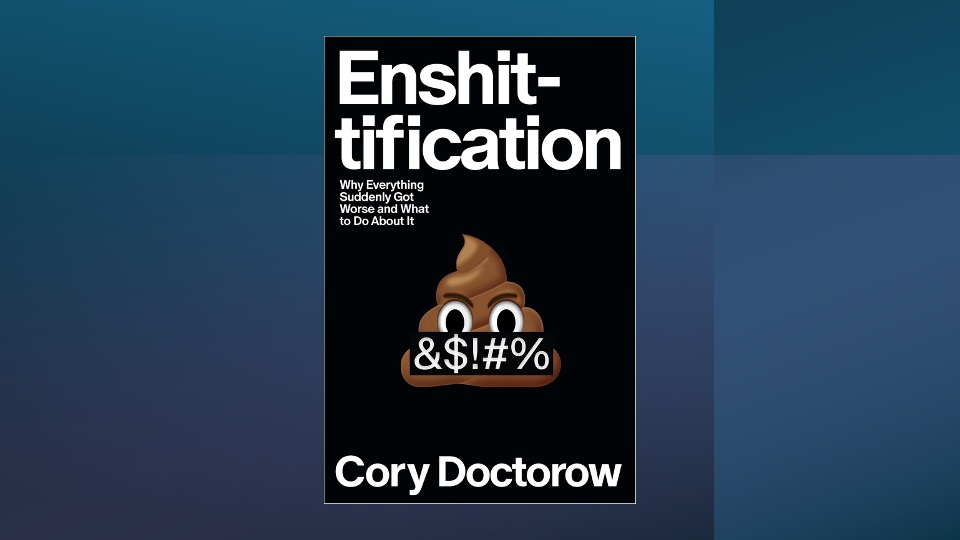
Cory Doctorow’s book dumps on the digital economy for its descent into the sewer, driven by exploitative practices toward its customers. Doctorow provides a case for why it need not be so in a text that is full of wit. Review by Jeremy Williams.
“Dirty words have political potency,” says Cory Doctorow of the term he coined for the exploitative turn taken by the digital economy. First using it in 2022, Doctorow captured the sense of eroding value on social media and other online platforms. The word went viral, and whether or not you appreciate its scatological irreverence, it’s too late now and it’s in the dictionary.
You’ve almost certainly noticed the phenomenon of enshittification. You go onto Facebook and see a slew of promoted posts, AI-generated imagery and clickbait before you see anything from an actual friend. Netflix is dropping more and more ads into programmes. The Amazon shopping experience is now stuffed with promoted items and if you haven’t got it already, you can’t check out without feeling bullied into Prime membership.
None of this is accidental, and there is a specific pattern to it. To the corporation, it’s a business logic. To everyone else, it’s a sequence of increasing abuse:
- First, platforms are good to their users. They use their investment money to keep prices down, and provide a seamless and excellent service. This builds the user base and encourages customer loyalty.
- Second, platforms sacrifice their user experience to improve things for business customers. Business users see increased traffic and engagement, and higher revenues. That encourages them to commit too.
- Third, the platform puts the squeeze on their business customers to improve things for shareholders. Money is made for investors, but the platform is trashed in the process.
Amazon, Facebook, Apple and Google are all at different points on this journey, and moving at different speeds. To my mind, Facebook has been a waste of pixels for five years. The Musk turned Twitter into a fascist bin-fire in the space of six months. Some are less obvious. Google has managed to avoid the bad press, but the pattern is visible when you look. Google engineers deliberately made their search engine less effective when they realised that they’d generate more ad revenue if people had to run more than one search to find what they were looking for.
This isn’t just a matter of inconveniencing people, either. There are some deeply unethical practices at work, with profound consequences for labour law and the economy. Amazon holds small businesses over a barrel across America, where the majority of households have a Prime subscription and start most of their shopping on Amazon. Woe betide the small business that tries to sell elsewhere. You just won’t get a look in. But if you join Amazon, the platform will hoover up your profits, as much as half , in return for high enough rankings in its search algorithm. Amazon is now a massive monopolistic middleman preying on the entire retail sector.
The banality of evil with an internet connection.
Uber’s algorithm is designed to offer lower wages to drivers it knows are desperate for the work, and the gig economy has become a political question. Facebook targets adverts towards people who show signs of depression, weaponising mental health in service of consumerism. Adobe made itself indispensable to an entire generation of designers, and then used their work on its cloud storage to train an AI design tool to replace them. This sort of thing is “the banality of evil with an internet connection”, says Doctorow.
Some will shrug and ask what we expected from capitalism, but that is to misdiagnose the problem, Doctorow warns. What we have here is more specific than that and it is better understood as feudalism. Drawing on the economics of Yanis Varoufakis, he summarises this new techno-feudalism as “an economic system where the majority of value is captured by people who own stuff, over people who do stuff.” Or to put it another way, “a fight over whether the landlord or the cafe owner gets the value created by the barista.”
President Biden made some big strides on antitrust. While I wouldn’t hold my breath on the Trump administration continuing that work, it is one of the very few areas of Biden’s policy agenda that the MAGA cult doesn’t want to burn to the ground.
Both the left and the right recognise the harm that rent-seeking does to the economy, and the book has plenty of solutions to present. Anti-monopoly legislation, or antitrust, has a proven legacy on both sides of the Atlantic. Competition regulators can and should rein in the tech giants, and a number of countries and regions have already done so. President Biden made some big strides on antitrust. While I wouldn’t hold my breath on the Trump administration continuing that work, it is one of the very few areas of Biden’s policy agenda that the MAGA cult doesn’t want to burn to the ground.
Another critical tool is interoperability, as platforms lock in users with very high exit costs. You might have years’ worth of music, books, or films on a platform, and it’s DRM-protected and only playable through their software. Walking away means losing your collection. Leaving a social media platform means sacrificing your network and contacts. Many of us keep using platforms we don’t like or trust because the switching costs are too high. Users need the right to exit, taking their networks and their digital goods with them.
Other solutions include collective bargaining for tech workers, which has held back the decline of Google in particular. Federated social media offers a more user-focused and democratic internet.
The internet didn’t used to be like this, and Doctorow makes a good case that it doesn’t need to stay this way. Change starts with naming the problem, and Doctorow’s witty and engaging book does this well – and you can always call it ‘platform decay’ if you’re talking to your grandma.