
Divya Priyadarshni tells a story of market success built on traditional practices without breaking the mold. And laments that it comes as a surprise.
Two years with the district administration of Jashpur — being embedded in planning meetings, village visits, and national exhibitions, watching buyers pick up a piece of Chhind palm jewelry and ask, with genuine surprise, where it came from — have given me one central conviction about this place. Jashcraft is a functioning economic system built on indigenous knowledge, sustained by forest ecology, and given institutional shape by an administration I have had the privilege of working within. This combination is rarer than it should be.
The crisis before the craft
Jashpur is a district in the forested highlands of northern Chhattisgarh, in central India—remote enough that most policy frameworks treat it as a margin. It is home to the Pahadi Korwa, one of India’s most at-risk tribal communities (formally designated as a Particularly Vulnerable Tribal Group, a government category for communities facing acute social and economic fragility), and to Oraon, Gond, and Malar communities—forest-dwelling peoples who have farmed, gathered, and crafted across these eight blocks for generations. These communities built a way of life around the forest. The question was whether that way of life was still holding.
Craft workers sold to middlemen at 30–40% of final retail value, with no direct route to market.
The picture on the ground was complicated. Young people were leaving. Substance abuse was fracturing families. Craft workers sold to middlemen at 30–40% of final retail value, with no direct route to market. Government schemes existed but were poorly coordinated, and many artisans had no way to access them. Low literacy made formal markets almost impossible to navigate.
This was the context Jashcraft stepped into: not a community frozen in tradition, but one under real economic pressure, with skills and materials that nobody had yet figured out how to connect to the right buyers.
How Jashcraft began
In 2016, a newly posted District Collector visited villages across Jashpur and listened. In Kotanpani village in Pathalgaon block, he found women from a self-help group (SHG) weaving palm-fiber jewelry, not as a hobby but as a source of income. Each necklace sold for ₹30 to ₹50 to local traders, who resold it for ten to fifteen times that price in urban markets.
That observation led to a simple but radical question: what if, instead of bringing industry to Jashpur, the district made its existing economy visible, valuable, and connected to larger markets?
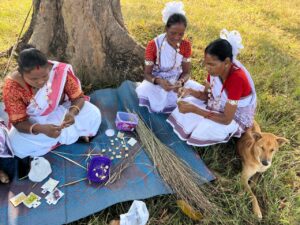
The administration began mapping the district’s craft ecosystem, not through a top-down survey but through village-level conversations. Block development officers, Anganwadi workers, and panchayat members met with SHG women, individual artisans, and village elders. They asked: What do you make? What do you earn? What do you need? These conversations were held in Hindi and local dialects, ensuring that people could describe their work and challenges in their own words.
From this ground-up process emerged the foundation of Jashcraft: a framework built on the district’s existing skills, resources, and aspirations rather than on externally designed solutions. SHG networks were formally structured from 2018 onward.
How Jashcraft Is built
Jashcraft has been organized since 2018 through a network of SHGs anchored in villages where Chhind palm, kansa, bamboo, and clay are in natural abundance. The model is deliberately low-capital. Raw materials are locally sourced and renewable. Tools are minimal. What the initiative invests in is aggregation, training linkages, and market access—not machinery or infrastructure. This means the model creates no dependency on government-provided equipment that may break.
Buyers are not just purchasing an object. They are purchasing its provenance, a story, and a connection to the people who made it.
Using locally sourced natural materials, communities produce a diverse range of handcrafted products, including jewelry, furniture, pottery, textiles, woodcraft, and traditional metalwork (see box, Jashcraft). In a consumer market increasingly tired of sustainability claims that cannot be verified, this traceability has proved to be the product’s most bankable quality. Buyers are not just purchasing an object. They are purchasing its provenance, a story, and a connection to the people who made it.
They are:
- necklaces, bracelets, decorative jewelry — entirely handwoven from Chhind palm fibre;
- bamboo furniture, trays, decorative items, organizers, and bouquets;
- ceramic traditional lamps, pots, surahi, kalash and decorative vessels;
- handwoven textiles including Tibetan-style carpets, yoga mats and traditional fabrics;
- handcarved wooden utility items, decorative pieces in traditional designs; and
- Cheenda-Kansa – traditional metalwork combining brass and copper.
In markets where sustainability claims are easy to make and hard to verify, this traceability matters. Buyers know exactly what they are getting and where it came from.
More importantly still, the community has a role in the decision making processes. In many rural development initiatives, when officials say ‘the community is central,’ they mean the community is consulted—then the government makes the decisions. Jashcraft is structured differently at all three levels (see box, Who actually decides?).
Village level
Self-help groups (SHGs) make daily production decisions: what to make, which materials to source, who works when. SHG Presidents — always women — sign off on bulk orders and pricing. This is authority, not consultation.
Block level
Block-level cluster coordination happens through Block Development Officers and SHG Federations. These forums discuss training schedules, quality standards, and market opportunities. Decisions are consensus-based where possible.
District level
The District Jashcraft Committee meets monthly. Members include: Collector, DFO, CEO Zila Panchayat, NRLM State Coordinator, DIC representative, and—critically—two SHG Presidents elected by SHG Federations. These two elected representatives carry voting power on district-level decisions about training, market linkages, and resource allocation.
Limits of the model
When resources are limited or conflicts arise, the government ultimately retains decision-making authority. The District Collector can overrule an SHG decision if it conflicts with district policy. That authority is real. In practice, however, such interventions have been rare and are typically accompanied by an explanation rather than imposed unilaterally. Likewise, an elected SHG president cannot simply be sidelined because a local government official disagrees with her. This balance has helped preserve both administrative accountability and community ownership.
The piece most often missing from rural craft initiatives is institutional backing. In Jashpur, it exists in full — structured across three roles that rarely pull in the same direction at the same time.
Three officials shaped what Jashcraft became: a collector who saw craft as economic infrastructure rather than a welfare programme; a forest officer who made ecology the non-negotiable starting point for every procurement decision; and a Panchayat chief who focused, unglamorously, on whether SHGs had the internal capacity to actually last (see box Jashcraft’s vanguard).
Rohit Vyas
Vyas brought a deep understanding of tribal economies and the vision to treat Jashcraft as an economic asset rather than a welfare scheme. Vyas personally took artisans to national exhibitions, created platforms where their voices could be heard by policymakers, and ensured the initiative received sustained institutional attention alongside the many competing demands of district administration. His leadership gave Jashcraft the visibility and credibility it needed to scale.
Sashi Kumar
Kumar brought rigorous conservation expertise and the conviction that ecological integrity is not a constraint on development but its very foundation. His guidance ensured that every procurement decision in Jashcraft was shaped by the question: how much can we sustainably harvest while actively regenerating the forest? This principle protected both the livelihoods and the forest—making the two mutually dependent rather than at odds.
Abhishek Kumar
Kumar contributed the institutional architecture that will make Jashcraft endure. His focus was on building the structural capacity of SHGs, ensuring they could manage income, maintain quality, absorb new members, and operate sustainably over the long term. This is the unglamorous work that determines whether an initiative actually lasts.
What has changed
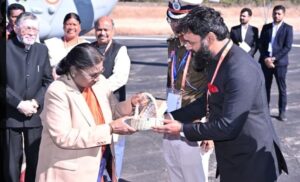
In December 2025, The Honourable President of India is Smt. Droupadi visited Jashpur and acknowledged Jashcraft. For those working on this initiative, it was a moment of satisfaction—not because the work needed external validation, but because visibility at that level opens doors for artisans.
The real outcomes are quieter and more material.
- Incomes have increased substantially. Where SHG women earned Rs. 500–1,000 per month from sporadic craft sales, they now earn Rs. 3,000–8,000 monthly from regular orders, with the highest-skilled weavers earning Rs. 10,000 and above. This is not about wealth. It is about the difference between living with constant uncertainty and having a stable, secure life.
- Youth migration has slowed measurably in SHG villages. Young women see craft-based work as viable, especially after completing 90-day training. They are not rushing to cities.
- SHG women have developed confidence and public voice. Women who could not speak in mixed groups now negotiate with buyers, present products to state officials, and speak at district meetings.
- Traditional crafts have been revived—especially Tibetan-style weaving and bamboo work, which had been declining. Young people now see these crafts as modern and respectable.
- Household nutrition and children’s school attendance have improved in participating families, correlating directly with income stability.
Rural growth does not always require new industries. It can emerge from taking seriously what already exists.
The meaning of the model
Bamboo here is not merely harvested. It is inherited—and that inheritance, with the right institutional support, turns out to be worth considerably more than it has ever been paid.
Rural growth does not always require new industries. It can emerge from taking seriously what already exists: skills, materials, social organization. The infrastructure already exists.
Sustainability is most durable when it is structural, not a branding choice. In Jashcraft there is no chemical processing, no pressure to over-extract, no investor demanding volume beyond what the forest provides. The ecology and the economy are aligned because they were never separated in design.
Jashcraft’s most valuable product may not be the jewelry itself. It may be the proof that this kind of approach works: that an economy built on what people already know and make can be formalised, connected to wider markets, and sustained — without losing what made it worth preserving.