
Lauren Leek says Britain’s pub crisis is about far more than pints. It is about the quiet disappearance of places that hold communities together.
My brother is coming to London and he has only one demand: beer. A lot of it. I am the wrong person to ask. I am the sort who gets up early for a run, prefers coffee to ale, and thinks a good Saturday involves a bike ride rather than a bar stool. But, trying to be helpful, I started looking into Britain’s pubs. What began as a practical exercise in planning a pub crawl quickly turned into something else.
Because this is not really a story about beer. It is a story about what happens when the places where people casually belong are stripped for value and treated as assets rather than anchors of community.
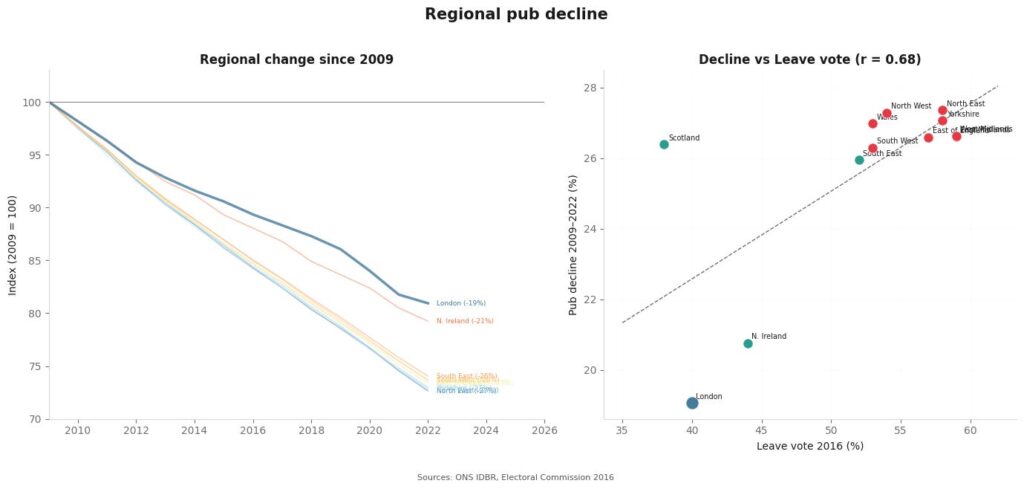
Over the past decade and a half, Britain has lost around 14,000 pubs. The decline is steep, sustained and national. Behind it lies more than a change in drinking habits. It reflects a deeper transformation in the country’s social fabric and economic model: the steady erosion of what sociologist Ray Oldenburg called “third places” — those everyday spaces that are neither home nor work, but where community is made.
Pubs matter because they are among the last institutions where people can simply turn up. No booking, no app, no invitation, no curated identity required. Just a room, some familiarity, and the possibility of conversation.
I have felt that kind of belonging in places far from Britain. In a tiny town north of Sydney, my team somehow beat the local regulars in a pub quiz and, by handing back the prize, crossed the invisible line between outsider and accepted guest. In rural Tuscany, after latching onto a local cycling group despite not speaking Italian, I ended up in a village bar sharing wine and route tips in broken sentences and wild gestures. In both cases, the place itself did the work. It made encounters possible.
That is what Britain is losing.
The easy explanation is that people simply stopped going to pubs. There is some truth in that. Drinking habits have changed. Supermarkets undercut pubs on price. Younger generations often drink less. But this story is too neat, too passive, and too forgiving of the forces at work.
The long decline predates Covid, the energy crisis and the latest round of inflation. It stretches back through years of pressure: punitive duty, business rates, austerity-hit councils, and a planning system that too often allows a pub to be converted or hollowed out before communities can react. The pattern is structural.
London has not so much kept its pubs as changed what many of them are.
And it is highly uneven. Some of the biggest losses have fallen in the North East, North West, Yorkshire and the Midlands — places that were already carrying the scars of deindustrialisation and disinvestment and where Reform UK thrives (see chart). London, by contrast, appears to have held up far better. But the capital’s apparent resilience is misleading. London has not so much kept its pubs as changed what many of them are.
To understand why some pubs disappear while others survive, it helps to think spatially. The pub that closes is often not simply the one with the worst management or the flattest beer. It is the one left too alone. Isolated pubs are more vulnerable. Pubs in clusters — where several venues support a local drinking and social ecosystem — are more resilient. Once one closes, the others nearby become more exposed. The loss accelerates. A social map becomes a death spiral. (See box – Check your local).
The model behind it is deliberately simple and that’s the point. For every one of Britain’s pubs, I calculate two things: how far away is the nearest other pub (nearest-neighbour distance, via haversine BallTree), and how many pubs exist within a walkable radius (pub density). Those two spatial signals get combined into a continuous risk score, then bucketed into green (clustered, resilient), amber (thinning), and red (isolated, vulnerable).
That’s it. No pricing data, no opening hours, no operator quality scores. Just structure and space. Because the finding from the closure analysis is stark: the single strongest predictor of whether a pub closed between 2016 and 2024 is how alone it was. Not how good the beer was or who owned it. But whether it had neighbours.
Enter your postcode and see every pub within walking distance, scored green/amber/red by the vulnerability model. The risk scores, not coincidentally, map onto the worst loneliness scores in the ONS wellbeing data.
The tool won’t tell you btw whether your local does a decent Sunday roast (I’m working on that model, it just requires some more field research). But it will tell you whether the spatial conditions around it look like the conditions that preceded every closure in the dataset.
But that spiral does not create itself. It has authors.
Britain’s pub sector has, for years, been shaped by the logic of extraction. In many cases, pubs are no longer primarily valued as places to gather, but as properties to leverage. Large pub companies and private equity owners acquire estates, load them with debt, squeeze tenants and operators, underinvest in the buildings, and sell off sites when the numbers no longer work. The pub becomes collateral.
This is not abstract theory. Some of the biggest operators in the sector sit within highly financialised ownership structures, sometimes running through offshore jurisdictions, burdened by billions in debt and driven by returns that have little to do with local life. In that model, a struggling pub is not a social asset worth preserving. It is a line on a spreadsheet.
The consequences are starkest outside the wealthiest places. In towns where land values are low, a closed pub often simply vanishes. In more affluent or gentrifying parts of London, the building may survive but the social function changes. The old corner pub becomes a branded bar, a taproom, a lifestyle venue. The name changes. The prices rise. The clientele narrows (see map).
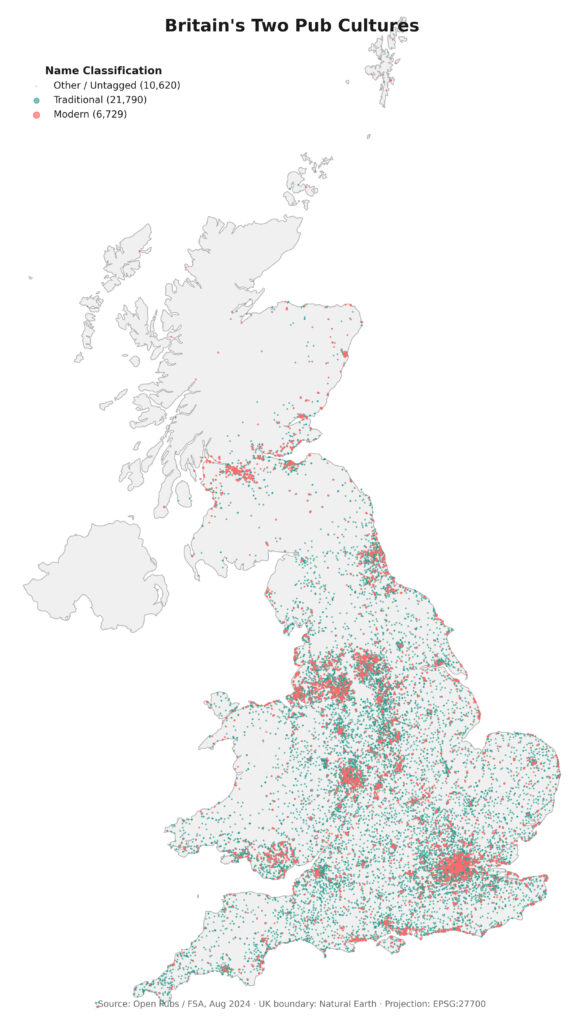
On paper, the numbers may still look healthy. On the ground, something has gone missing.
Saving a pub is often cheaper than building a new community institution from scratch.
This is why the decline of the pub is not just about hospitality. It is about access. Traditional pubs, clubs and locals historically offered cheap, low-threshold social space. They were not perfect institutions. Some were exclusionary, some tired, some stuck in old habits. But at their best they provided an ordinary setting in which a wide social mix could share the same room.
That matters more than policymakers often admit. Britain now spends money trying to repair the effects of loneliness and fragmentation after the damage is done — through social prescribing, community programmes and public health interventions. Much of that work is worthwhile. But it is downstream. It treats the symptoms after the social infrastructure has already been dismantled.
Saving a pub is often cheaper than building a new community institution from scratch. More importantly, a pub already carries memory, meaning and ritual. It is woven into place.
So what should be done?
First, Britain needs to start treating third places as real infrastructure. They should be mapped, measured and understood as essential to civic health, not as optional extras. A neighbourhood without places to gather is not socially well-served, however strong it may look on narrower metrics.
Second, vulnerable pubs need stronger protection. Planning rules should make conversion harder, not easier. The Asset of Community Value framework has shown what is possible, but it is too patchy and too dependent on whether local people have the time, knowledge and capacity to mobilise quickly.
Third, there should be serious support for community ownership. Across Britain, community-owned pubs have shown that another model is viable. When local people own the freehold, profits are more likely to stay local, decisions are more accountable, and the pub’s role as a social institution can take priority over extraction. The Ivy House in south London became a celebrated example of what can be saved when a community steps in. It should not be an exception.
If community assets are being treated as vehicles for rent extraction, then the tax and regulatory system should respond.
Finally, policymakers need to confront the ownership question directly. If community assets are being treated as vehicles for rent extraction, then the tax and regulatory system should respond. Britain cannot go on lamenting the loss of its social fabric while leaving the underlying incentives untouched.
My brother will still get his London pub crawl. But it now feels like more than a drinking itinerary. It is a journey through layers of British history: heraldic inns, Victorian locals, reinvented craft spaces, the remnants of a pub culture that once held neighbourhoods together.
The point is not nostalgia. The point is that places matter. When they disappear, the loss is larger than one closed business. A country without third places becomes lonelier, less trusting and easier to divide.
Britain did not just lose 14,000 pubs. It lost thousands of informal civic rooms. And unless it changes course, the next local to go may not just be a pub. It may be one more piece of the social world that makes people feel they belong.
Read the full blog version on Lauren’s Substack here.