Alan Freeman explains why China’s pole position in the artificial intelligence race might be down to sharing rather than competing.
When Chinese artificial intelligence (AI) company, DeepSeek, released its R1 model, the predictable clichés arrived on schedule: a “cheeky upstart”, a “Sputnik moment”, a sudden shock to American tech markets. But once the adrenaline fades, the more interesting question is not who got surprised, but what kind of shift this release signals — and why China seems better positioned to exploit it.
One seasoned observer, Java mobile pioneer, Samir Mitra, called it a “Linux moment”. That comparison matters, because it directs attention away from the usual Silicon Valley storyline — venture capital, proprietary breakthroughs, first-mover advantage—and toward something more structural: open source as a different way of organising technological power.
It looks more like a move in a longer transition: away from technology as private property locked behind paywalls, and toward technology as an open, iterated, collective resource.
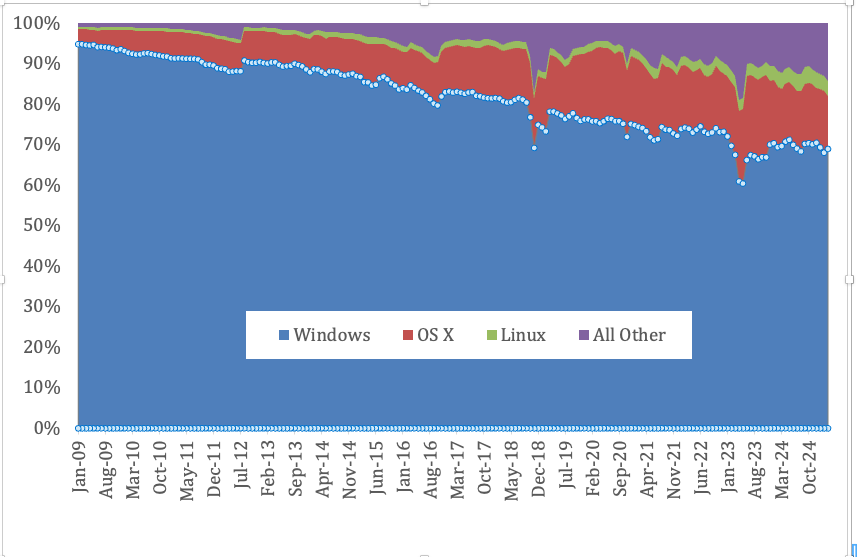
Linux didn’t “launch” in the way iPhones launch. It appeared, got shared, got improved, and—crucially—never went away even on desktop PCs (see chart). A volunteer-built operating system became core infrastructure for servers, smartphones, and much of the internet. DeepSeek, the argument goes, isn’t just a one-off model release. It looks more like a move in a longer transition: away from technology as private property locked behind paywalls, and toward technology as an open, iterated, collective resource.
A different kind of property
People often describe open source as a moral stance (“sharing is good”) or a pricing strategy (“it’s free”). That misses the harder point: open source works because it encodes a property regime—rights and duties—designed to keep knowledge usable by others. It consolidates “open access” rules into a productive system: the code can be used and adapted by anyone, under defined terms, rather than sold like a scarce commodity.
That matters because digital technology has an awkward feature: once created, it is cheap to copy. A poem, a theorem, a design, a software library — these are not like barrels of oil. You can share them without losing them. The more easily something can be copied and used by others, the harder it is to treat it like a conventional commodity whose value depends on exclusion. In plain terms: ideas are easy to spread and hard to fence in.
For decades, capitalism worked around this problem by commodifying not the ideas themselves, but the means of reproducing them. You didn’t pay for music “as such”; you paid for vinyl, tapes, CDs, concert tickets, broadcast access, cinema seats. The costly part was distribution. The internet reversed that. Once distribution collapsed toward near-zero cost, the old business model – charge for access to the copy — became unstable.
DeepSeek lands right in the middle of this long collision between digital reality (copying is cheap) and proprietary business models (copying must be controlled).
Mental objects
One way to make sense of this is to stop talking vaguely about “information” and start talking about mental objects: non-material entities—software, theories, designs, texts, images—that can exist in many physical forms without losing their identity. A book is not the paper it’s printed on. Burn the pages and the content can still survive in minds and other copies. Digitisation didn’t invent mental objects; it removed their dependence on any particular material container.
That liberation changes production. In the industrial era, machines eventually produced machines: a tipping point that supercharged output. In the digital era, mental objects increasingly produce mental objects: software tools build software tools; models help generate code; repositories accelerate iteration; open libraries become scaffolding for new systems.
The United States tends to treat intellectual property primarily as a weapon of competition—something that prevents rivals gaining capability.
DeepSeek’s success, in this framing, is not mainly about clever engineering (though it includes that). It’s about being positioned inside an ecosystem that treats these mental objects as a shared productive base—something to be disseminated and recombined—rather than something to be locked up as private toll roads.
So why does China seem to be playing this better than the US? Start with a blunt contrast: the United States tends to treat intellectual property primarily as a weapon of competition—something that prevents rivals gaining capability. China, by contrast, has pushed hard on capability diffusion—getting know-how into the hands of more people and more firms, faster.
The textbook example is industrial policy by joint venture and technology transfer. Whatever you think of the politics, the mechanism is straightforward: if you want access to China’s market and production base, you often had to share not only patents, but operational competence—how to actually do the thing at scale. That mindset aligns naturally with open source: growth comes from spreading usable knowledge, not hoarding it.
This also shows up in China’s broader international posture, which it frames as “shared prosperity”—and in practical cooperation across supply chains and infrastructure. You don’t have to buy the branding to see the strategic consequence: diffusion builds a thick layer of competent producers, engineers, and implementers.
The second difference is labour. In much Western commentary, China is reduced to cheap work and harsh conditions. That story is both incomplete and strategically misleading. The more decisive point in an AI-and-software economy is not cheap labour, but skilled labour at scale—people who can build, adapt, implement, and iterate.
The “weightless” digital economy still sits on heavy physical foundations—chips, networks, data centres, logistics, devices.
AI also scrambles the popular fear that “machines will replace humans” across the board. The trend described here is the opposite: labour shifts away from what is easily mechanised and toward what machines struggle to replace—creative work, high-skill design, complex human-facing services. In this view, the future economy leans harder on human capability, not less. Societies that invest in skills and treat people as the core productive resource will outperform societies that treat people as costs to be minimised.
Another inconvenient fact: the “weightless” digital economy still sits on heavy physical foundations—chips, networks, data centres, logistics, devices. A major claim here is that China’s strength in mental production is reinforced by its manufacturing capacity, which gives it resilience against external pressure and supply disruption. If you can’t secure hardware, you can’t secure AI at scale.
That’s why it’s a mistake to read the decline of industry’s share of employment or value added in the US as evidence that “industry doesn’t matter”. It matters enormously; it just employs fewer people because productivity is high. The service-and-platform giants still rely on manufactured infrastructure. China has worked to keep that base thick and strategically available.
What DeepSeek reveals
DeepSeek is best understood less as a single product and more as a signal: we are moving into a phase where the central productive inputs and outputs are increasingly mental objects—and where open access regimes can outcompete exclusionary ones by accelerating diffusion, iteration, and adoption.
In that world, the decisive question becomes political-economic rather than purely technical: what kind of property system, and what kind of social organisation, best supports the rapid development and wide deployment of these new productive forces?
The US model—highly financialised, aggressively proprietary, dependent on locking users into closed ecosystems—can still generate spectacular profits. But profit is not the same as capability. And it may be poorly suited to an era in which the most powerful technologies are those that spread fastest, recruit the most co-producers, and become infrastructure rather than products.
China’s approach—capability-first, diffusion-oriented, backed by a deep industrial base—looks, at least in this case, better aligned with the realities of digital production.
DeepSeek didn’t have a “moment”. It joined a movement. And if the movement is open source, the “AI war” may hinge less on who invents the next model first, and more on who builds the most powerful ecosystem for turning shared knowledge into collective capability.